
In this article
Today, we're open-sourcing OpenHack v2, our newest AI security harness. It comes with a new web interface and scored the highest catalog F1 of the six configurations in our latest PentestBench evaluation.
Open-sourcing the harness
A harness controls how a model gets context, uses tools, and investigates an application. We built OpenHack's harness for finding security vulnerabilities.
We're making the code public so you can see how it works, try your own changes, and contribute fixes. If you're working on AI security tools, we'd like to hear what you find useful and what needs work.
A beautiful new web interface
We've also built a new web interface for OpenHack v2. Watch the video above for a walkthrough.
How the harness works
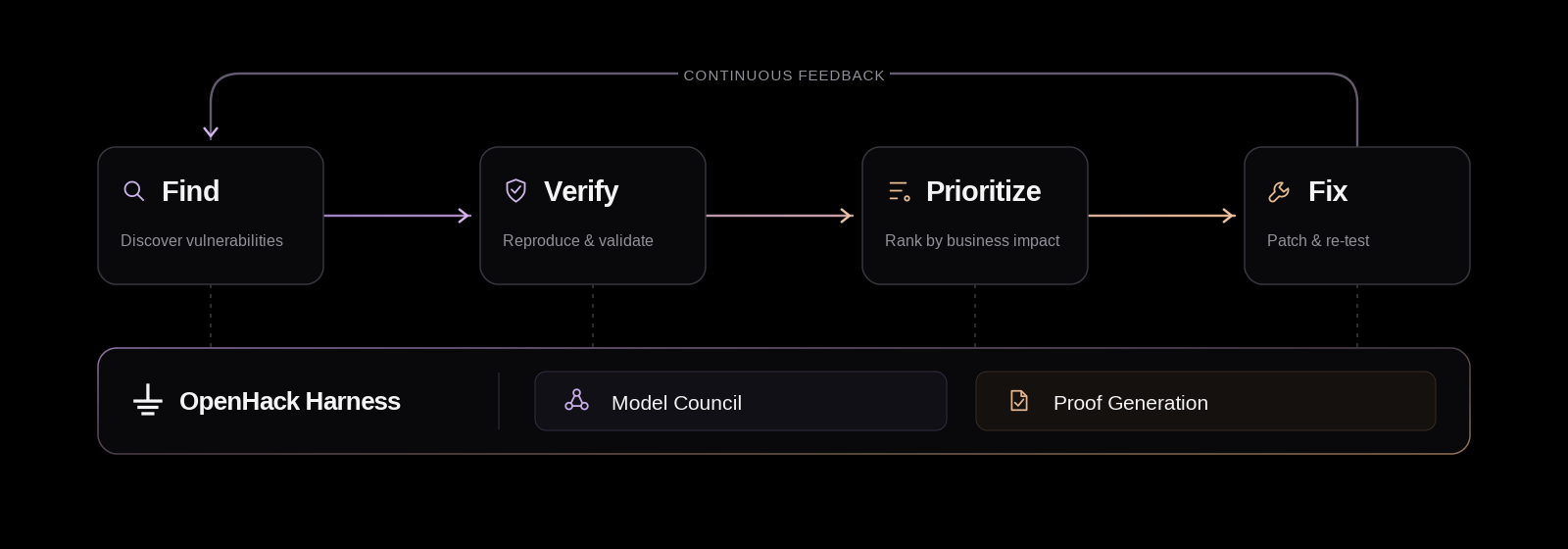
OpenHack's security workflow has four stages: find vulnerabilities, verify them, prioritize by business impact, and fix them. The model council reviews the findings. Proof generation tests whether an exploit actually works.
Model council
Finding a suspicious line of code is the start of an investigation. The council gives each candidate three separate reviews:
- Advocate: builds the strongest case supported by the source, checking attacker control, reachability, and impact.
- Skeptic: tries to disprove the finding by checking defenses, authorization, framework behavior, and the conditions an attacker would need.
- Judge: reads the source and both assessments, then decides the verdict and severity.
The public scanner withholds confirmation when those reviews disagree. Unresolved findings stay uncertain.
Proof generation
In the runtime proof pipeline used for our evaluation, surviving findings go through exploit testing. The pipeline develops a proof of concept and runs it against the original application and a copy with a minimal fix applied. The exploit must succeed on the original and fail on the patched copy. A benign control must still work in both, so breaking the application doesn't count as fixing the vulnerability. The proof then receives an independent review.
The diagram shows the broader OpenHack workflow. The public scanner currently performs source review; it doesn't execute project code or apply patches. Runtime proof generation is a separate part of the evaluation pipeline.
OpenHack v2 surpasses Claude Code Security
We evaluated OpenHack v2 on PentestBench: 17 web applications with 761 planted vulnerabilities. In the November 16, 2026 results, OpenHack v2 with Mythos 5.2 achieved 43.21% catalog F1, the highest score among the six configurations evaluated.
OpenHack v2 found 277 of the 761 planted vulnerabilities, with 36.40% recall and 53.17% catalog precision. Catalog F1 combines those two measures: how many planted vulnerabilities a tool finds, and how many of its reports match the catalog.
Each score measures the model and harness together. The candidate findings and application source stayed the same. We also maintain PentestBench. Read the benchmark announcement for the methodology and limitations.

Ananay Arora
Founder, OpenHack